czwartek, 21 grudnia 2017

Check the Czech Christmas

Wesołych Świąt!

Christmas time is knocking on our doors and I am going back to see my family for the holidays. But before I leave I would like to present to you some Czech traditions and what Christmas looks like in my family 😊

Soo, where to start?

The main holiday for Czech people is the 24th December, we call it Štědrý den.

It should be a day of fasting (for some it means not eating at all, for some just avoiding meat) and there is a saying that if you manage not to eat, you will see the Golden pig (Zlaté prasátko). And Kofola (the Czech version of Coca cola but a bit spiced and much much better!) made a joke out of this saying in a commercial, it has been more than ten years and they have been playing it during Christmas time ever since, it has become probably the most popular commercial ever!


If you don't want to starve until dinner, you can cook a simple dish called Kuba, made from groats and mushrooms.

But be sure to keep enough space for the most important meal, the dinner - Štědrovečerní večeře. 

The protagonist here is carp fish. There are more traditions connected with carp than only the dinner so lets starts from the begining. A week or so before Chrismas the streets get flooded with barrels of fish where you buy a living carp or have it killed and unboned on the spot. Some people who buy alive, later put the fish into a bathtub, which is an old habit kept from the times when people did't have fridges.


Carp meat is cut into horse shoe shapes, deep fried in the triple layer crust (flour, egg, bread crums)
and served with potato salad as the main dish. The soup is also made from carp and you can use pretty much everything that is left from the fish so typicaly you make broth from the head and little cut offs together with root vegetables and later you add also the roe and milt 🐟😉

Me and my mom don't like carp so we prepare a different fish so there is only one traditional horseshoe carp on the table
And it goes even more "zero waste" because you don't even trow away the scales, you wash them and give to all family members to keep them in their wallets because they are supposed to bring you money! 💰 (You can also put them under your plate during the dinner)

Then comes the time to open presents. Normally "Ježíšek" (baby Jesus) brings them before the dinner, when the children are in another room and rings the bell, they run to the tree trying to see Ježíšek, but he is always gone. In my family we first eat and then all sit around the tree, eat some Christmas cookies and open the presents one by one throughout the whole evening.

Some people go to the midnight mass, but my family is not religious and we are lazy to move after all the food 😆 Instead we attend a midday singing in the town next to us where my aunt, uncle and sometimes also my cousins sing. It is a nice gathering where you meet many friends and acquaintances, wish them "Veselé Vánoce!" and drink some grzane wino.


There also many traditions for predicting future done during Christmas, some more known and popular. For example you can cut apples in half and if you see a star, everything is ok but if you see a cross inside, then you will die the next year. Not very positive. Or single girls kick shoes behind them and if the shoe is pointing in the direction of the door, she will get married and leave the house, if it is away from the door she will stay one more. Something similar works also with little boats made of nut shells with candles inside, if your boat separates from the others you will probably travel somewhere, if it drowns, bad things happen.

Some people celebrate only the 24th, some people also the 25th, some (like my family) even the 26th!

On the 25th we meet with my aunt, uncle and cousins for lunch either in their house or ours (depending on where is my grandma staying, because we take turns who will have her on the 24th each year😊), we drink some better champagne, eat stuffed turkey and open another round of presents.


On the 26th we all go to my grandmother's little flat and we eat goose with dumplings and sour cabbage. I love this meal so much!!! 😍 After that we go together to light candles at my grandfather's and a few more graves. Also we have a little tradition to light as many candle as possible at the INRI cross (the one that are already there). And that's it!


Ok, now I need to catch my bus home because I don't want to miss all of this!

I wish you all "Wszystkiego najlepszego", enjoy the holidays and see you in 2018!!!

Christina 


piątek, 7 października 2016

Cooking session


Cześć everyone,

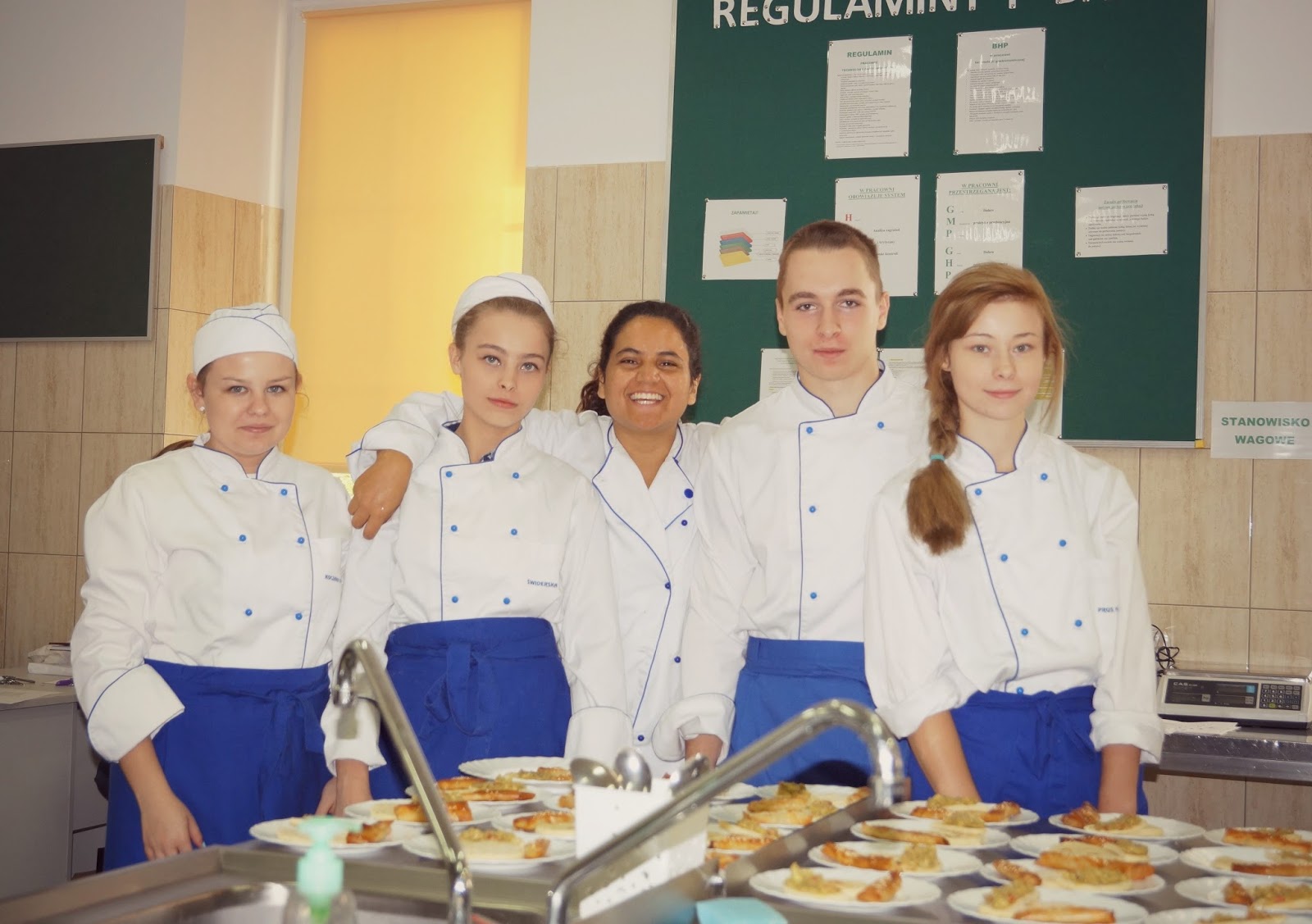
 On the 22nd of September, Angélica, Marie, Tuğçe and I were invited at a vocational school that is part of a group of schools named “Bolesława Prusa”, in Pułtusk. The aim of our workshop was to introduce and cook some culinary specialties from our countries with a group of students, who are training to become cooks. We started off the session by telling them a bit more about our country’s food habits, as well as about the Colombian, Turkish and French dishes that we were going to cook together during the next three hours. Each of us was in charge of a small group of four or five students and after splitting the class, we started to cook. Here is what was on the menu of the day for each country!

* Colombia:
Angélica introduced her group to Colombian corn pancakes, called “arepas”. To go with those pancakes, her students also learned how to make “guacamole”, an avocado-based dip. Finally, they also discovered how to prepare a typical drink made of sugar cane, “aguapanela”. Buen provecho!

* Turkey:
Tuğçe taught her group how to cook “börek”, little savoury pastries made of a thin dough called "yufka" and filled with potatoes and herbs. Her group also learned how to make “biber dolmasi”, green peppers stuffed with rice and spices, as well as “ayran”, a drink made of yoghurt.  Afiyet olsun!
* France:
As Marie and I are both French, we decided that one group would cook salty food and the other one sweet food. Thus, I showed my group how to make a “cake au jambon et aux olives”, a typical ham and olive savoury cake. Being from Lyon, I also introduced them to a culinary specialty from my city, “la salade Lyonnaise”, a mixed salad made of lettuce, bacon, croutons (grilled bread pieces) and poached eggs.
 As for Marie’s group, they learned how to bake “chouquettes”, French little choux pastries springled with pearl sugar and were introduced to one of Marie’s family favourite desserts: “la tarte aux poires renversée”, an upside-down pear tart named that way because the dough is added on top of the pears and not the contrary. Weird, we know, but still delicious!  Bon appétit!

It was so much fun teaching the students how to cook and bake dishes very different from what they are used to. They were very motivated, curious and eager to learn and it was a very enriching session, for them but also for us. They learned new recipes and sometimes discovered unusual flavours, while also practising their English. 
As for us, we learned how to organise a group, how to use mimes, body language and other solutions to overcome the language barrier that sometimes appeared during the session, as well as how to deal with problems on the spot and how to find solutions all together. We also learned about the cooking techniques they use and some very useful Polish vocabulary related to kitchen. We were very proud of the results of that mutual exchange and of course, the end of the lesson was saved for tasting the various dishes, a moment enjoyed by everyone!
We would really like to thank the teachers and the students who invited us; it was such a nice and convivial intercultural moment, during which we all learned from each other. We will be more than happy to come back at any time! 

Do zobaczenia,

Julia


wtorek, 22 września 2015

Kuchnia węgierska


Zupa gulaszowa
Składniki na zupę:
-           2 cebule , posiekane
-           1 kg wołowiny, pokrojone w kawałki
-           papryka w proszku ( słodka lub pikantna )
-           3 ząbki czosnku
-           olej
-           papryka zielona, posiekana
-           papryka żółta
-           pomidor
-           1 seler (z liści ) + posiekanej natka pietruszki
-           0,4 kg ziemniaków
-           2 marchewki
-           1 biała marchewka
-           1 łyżka soli
-           ½ łyżeczki kminku , 2 liście laurowe
Składniki - makaron :
-           2 jajka
-           160 g mąki
-           1 łyżeczka soli

1. Podsmaż posiekaną cebulę, czosnek i mięso w garnku na oleju. Dodaj paprykę w proszku, sól i ½  szklanki wody .
2. Dodaj pomidory , żółtą papryka, liście laurowe i wypełnij garnek z wodą . Gotuj przez 60 minut .
 Przygotuj makaron w międzyczasie :
3.Wymieszaj wszystkie składniki na kluski.
4.Uformuj z ciasta kluski .
4. Dodaj warzywa: marchew, seler, pietruszka, ziemniaki do bulionu. Gotuj przez 30 minut ( jeśli potrzeba dolej wody )
5. Gdy wszystko jest gotowe , dodaj do garnka uformowany makaron i gotuj przez kolejne 10 minut.

Leczo
-          3 pomidory
-          3 cebule
-          3 papryki ostre (np. zielone)
-          3 papryki żółte
-          węgierska papryka w proszku
-          węgierska kiełbasa
-          oliwa
1.Pokrój paprykę w krążki, pomidory na mniejsze kawałki, posiekaj cebulę.
2.Do garnka wlej oliwę i dodaj cebulę. Poczekaj, aż cebula zmięknie.
3. Dodaj pomidory. Gotuj, aż będą miękkie.
4. Dodaj paprykę i również gotuj do czasu, aż papryka zmięknie.
5.Przykryj garnek i gotuj przez 5 minut na wolnym ogniu.
6.Dodaj węgierką kiełbasę pokrojoną w krążki. Przypraw papryką w proszku.
7.Gotuj jeszcze przez parę minut.
Smakuje na zimno jak i na gorąco! 


Kluski twarogowe
-          0,5kg twarogu
-          3 jajka
-          2 łyżki oleju
-          bułka tarta
-          szczypta soli
-          cukier w proszku
-          kwaśna śmietana

1.Wymieszaj twaróg, jajka, sól i cukier. Odstaw na jakiś czas.
2.Uformuj kulki i gotuj je w wodzie aż będą miękkie.
3.Usmaż na oleju bułkę tartą.
4. Obtocz kulki w podsmażonej bułce.
5.Podawaj z kwaśną śmietaną.


Langos
-          0,5 kg mąki
-          0,3 kg drożdży
-          200ml mleka
-          woda
-          olej
-          sól
-          olej do smażenia
-          śmietana , czosnek i ser do smaku

1 Drożdże wymieszaj z gorącym mlekiem. Dodaj mąkę i wodę i dokładnie wymieszaj. Posól.
2.Odstaw na 20 minut
3.Po tym czasie zacznij formować małe kuleczki z ciasta i smaż na oleju ze wszystkich stron.
4.Na koniec posyp czosnkiem, serem lub śmietaną ( jeśli ktoś lubi może uczyć wszystkiego naraz).


 Oraz na koniec tortilla de patatas w wykonaniu Carlosa i uczestników projektu! :)