poniedziałek, 8 kwietnia 2019

Warsaw Food Guide (from volunteer Ayse)

I have just come from my EVS after amazing 1 year with extra 3 kilograms. Because eating was both my
and my coordinator’s favorite activity which I already miss, so I thought it would be good to share my
food adventure in Warsaw as a volunteer.


Zapiecek

This is the most Polish place you can ever find. It has very traditional, grandma-style decoration, there
are even dollies on the table and perfect place for pierogi, placki ziemniaczane and traditional soups.
You will totally love huge portions, sour cream on the top of the pierogi and hot kompot. It has more
than 20 kinds of pierogi both boiled and fried options. My favorite is fried pierogi with cabbage and
forest mushroom. Avarage price for 9-pierogi portion is 23zl, Polish suasages are 26zl and soups are
around 10zl.


Mleczarnia Jerozolimska – Milk bar
If you hate cooking and you need to survive with volunteering money like me, milk bars are definitely life saving. In the mid-60s, during communism era, restaurants were nationalized because they were “capitalist” and milk bars started to serve cheap, dairy based and vegeterian foods to workers.  After communism collapsed, milk bars went bankrupt however in 2010s they came back as fast-food restaurants for Polish traditional food and they are still cheap! A typical lunch option with soup, main course, salad and kompot is around 20zl, a portion of pierogi is around 10zl and my favorite meal potato crepes with spinach is only 11zl. Leniwe and tomato soup are definitely must try.

Asia Tasty
I can easily say my spice tolerance has increased in Poland but not because of Polish food because of authentic Vietnamese food in Poland. Poland and Vietnam relations grew in mid 1900s with student exchange programs while both countries were communists. Now, Poland is home of almost 60.000 Vietnamese people. You can easily find a Vietnamese restaurant even in suburbs in Warsaw but one place is our favorite. It is cheap, fast and delicious. There is also a supermarket inside where you can find asian snacks, instant noodles, different rices and sauces from Asia.


Sapko Kebap
I never understand why people eat kebap in foreign countries because it is more like frozen kebaps sold in supermarkets in Turkey and not good. But this place has really good meat and delicious authentic side dishes with olive oil, tomato and eggplant. Döner wrap is around 15zl, Iskender kebap is 22zl. As a Turkish I approved!


 Hala Gwardii

Hala Gwardii is an amazing experience. It is a street food market where you can find delicious food from all around the world. Best thing is the most of the places are vegan/vegetarian friendly. Also they serve foods with wooden fork and knife in eatable plates in order to decrease plastic waste. There is a craft beer place you can buy regional beers from Poland. My favorite food stall is Tel Aviv and its amazing falafels. There are also thematic weekends with different activities but it is only open from Friday to Sunday. 


piątek, 1 lutego 2019

Trevas Asian kitchen


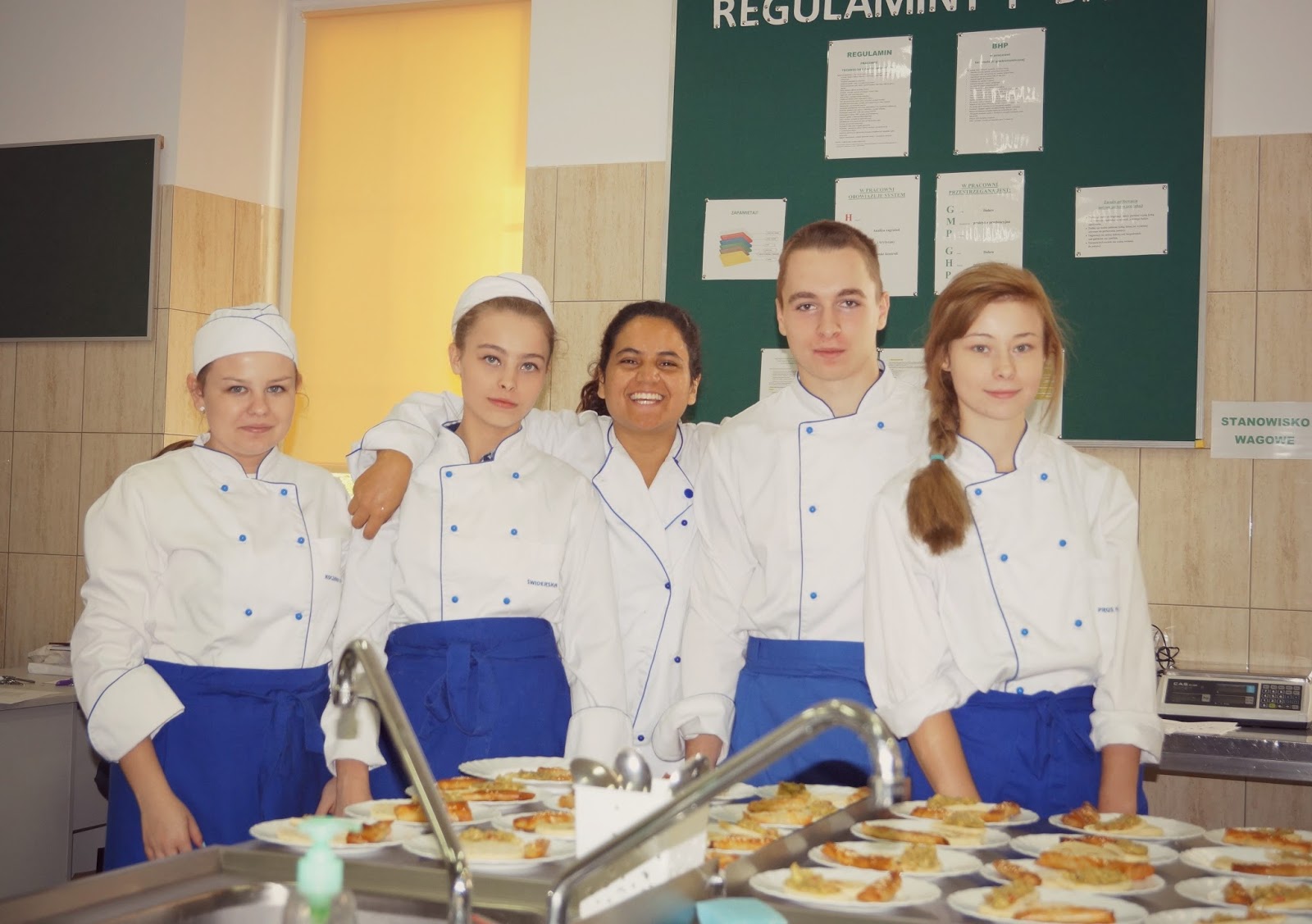
the recipes come from the cooking workshop in Prus School on 21.01.2019 and it was run by Trevas our Erasmus+ volunteer.
Fresh spring rolls:
Rice sheets 1 pack, varieties of vegetables (carrot, cucumber, bean sprouts, radish, lettuce,
spinach), vermicelli rice noodles, surimi “crab fingers”, jam , sweet and sour sauce
- To shred all the vegetables (carrot, radish – with a greater, cucumber, lettuce,
spinach – with a knife).
- Tear crab fingers into smaller pieces.
- Cook the rice noodles and coll down.
- Brush rice sheet with water to soften.
- Put veges, crab fingers and rice noodles on it and roll, add a bit of jam to each roll.
- sweet & sour sauce as dipping.


Sesame oil ginger soup:
Mushrooms 1 little pack, ginger 1, sesame oil 1 bottle, carrots, radish, chicken breast,
vermicelli rice noodles (example: beehoon).
- Soak the mushroom with hot water for half an hour.
- Chop veges into brunoise.
- Chop chicken breast  into cubes.
- Fry ginger in sesame oil till golden brown.
- Add water (chicken stock if have) and veges in.
- Simmer till veges are softened, then add chicken cubes.
- Cook noodles in a separate pot.
- Serve in a bowl.


Fried rice:
Soy sauce, scallion 1, eggs 10, rice 10 serves, Taiwanese satay sauce, meat
(optional, normally pork or chicken), lard
- Cook the rice “al dente”
- Finely chop scallion and dice meat.
- Melt lard in a frying pan, fry eggs, then chicken & add rice at the end.
- season with soy sauce & satay, sprinkle - scallion on top as garnish.


Mapo Tofu:
Tofu 1 block, 1 piece of beef with some fat, chilli flakes, scallion, chilli bean paste, garlic, in original:
 fermented soya bean
- Chop tofu into cubes. Poach tofu with some salt (put into hot water with a bit of salt for 3 minutes).
- Fry chilli flakes and mill into powder-like, put on the side.
- Panfry minced beef till golden brown, add chilli bean past (and fermented soya bean), add finelly
chopped garlic.
- Add some water and tofu.
- Thicken the sauce with flour, about 3 times.
- Garnish with scallion.


poniedziałek, 3 grudnia 2018

Independence day at Serock with mentally diverse people!

On the 8th of November our team of volunteers was kindly invited to Serock to collaborate in the activities the center had prepared for its users in commemoration of the 100 years of Polish independence. After a short presentation about the function of the institution and a comforting lunch the activities started. To run the workshops the participants and we were divided into three groups, so that they would have 45 minutes of each activity. Travis showed how to make origami, Ann-Katrin went outside to play some sport games, and Marine and I chose to help with the cooking part.
We were going to make some snacks, sandwiches and brochettes, for the party afterwards. The table was filled with different kinds of vegetables, cheese and cold meat, as well as butter and bread. The participants were all into it. They created really interesting combinations of flavors and the result was very colorful and tasty. Our main task was to help cut the vegetables and to hand them the food that were further on the other side of the table, but we also enjoyed a lot making our own sandwiches and brochettes. Listening to the participants asking us about some particular product was actually a great way to learn the Polish words for this kind of food!
Once the workshops were over it was time for the bonfire. All the group gathered around it to warm us up a bit. We could also bake some sausages and potatoes, and all of the time there were two men singing and playing the guitar, so the atmosphere could not have been more friendly!
But the day was not even close to finish yet. When it was too cold to stay outside we went indoors again to a room in which they had prepared a discotheche, it even had the classic silver shinny ball! The main music played was the already so familiar to us “discopolo,” and everyone was so happy dancing to its rhythm. The night was just getting better because there were also tables with the sandwiches and brochettes we had prepared at the workshop, as well as drinks, fruit, cakes and other sweets.
After a while of free time there, the workers made a quiz about Poland for the participants –in which we could not participate due to language barriers, but later we took part in the games. First we decided to teach them the English song “head, shoulders, knees and toes,” and it was very funny since every time we went faster and faster. Then they wanted to dance the “Macarena” song, for which I was very excited since I did not know it was also popular beyond the Spanish borders, but everyone knew the steps! We also played the chairs game and some other ones about dancing in pairs with balloons. We did have a good time and lots of laughs.
The night had come to an end, so everyone went back to their rooms. However, we still were up for a while talking to our neighbors, two nice workers of the center who spoke English, and they told us more about their experience there, and it was great to get to know them a bit. Finally, we left the next morning after breakfast. We were exhausted but very happy to have participated in the event, and I really hope we get to go there in more occasions!

piątek, 21 września 2018

Japanese workcamp

Between 9th and 19th of September we had the chance to host in Pułtusk three motivated Japanese students who came here to share their culture with Polish students. Meet Ryotaro, Genki and Haruka!


Haruka
Ryo
Genki

Our three Japanese participants and their Polish group leader Daniel stayed in Hostel Polon and another Polish participant Zuzia who joined the project at last moment stayed at her home in Pułtusk and participated during the day.


The main part of the project were visits to schools and presenting Japanese culture to the students. We visited school nr. 1 on Wednesday and Thursdays with presentation, workshops and quizes for 4 groups.


Then on Friday we made a lot of origami with the younger kids, cleaned a pavement and planted trees in the schools garden.


In the afternoon we played Japanese games in the culture center and after celebrated in Kamienica :)


On Monday we presented Japan in Prus and on Tuesday we cooked there with the students.


During their free time, we prepared a bbq and a campfire, the volunteers tried to make their own pierogi, went canoeing, drank wodka, picked mushrooms, played football and more.. ;)


Thank you so much dear friends!!!


piątek, 15 czerwca 2018

Cooking in Prus

Prus school invited us to cook together with the students.

The first meeting happened in May and we prepared our national dishes. The students were divided into four groups and followed the instructions of one of us volunteers.

Gizem and her team cooked Turkish yoghurt soup and Karniyarik, which is an eggplant stuffed with minced beef.

Gizem and Emil posing with their creation 😻

Me - Christina and my team made Czech garlic soup and Yemista - vegetables stuffed with rice (favourite dish from my Greek grandma 💓) 

Yummy!

Liza's team prepared the most amazing cake ever - chocolate with cream and cherries 🍒

Schwartzwalder kirshtorte
And finally Sergio's girls helped him with empanadas and guacamole! Unfortunately, I cannot find a picture... But it was so tasty!!! 💚


Then this Wednesday we cooked Polish lunch.


On the menu, there was: rosół, schabowy and potatos, mizeria, young kapusta and sernik.

And of course KOPEREK in every dish (except the desert..)

Sergio performing the most important task of all - cutting koperek!

Thank you so much, the food was amazing, hope to see you again soon!

czwartek, 21 grudnia 2017

Check the Czech Christmas

Wesołych Świąt!

Christmas time is knocking on our doors and I am going back to see my family for the holidays. But before I leave I would like to present to you some Czech traditions and what Christmas looks like in my family 😊

Soo, where to start?

The main holiday for Czech people is the 24th December, we call it Štědrý den.

It should be a day of fasting (for some it means not eating at all, for some just avoiding meat) and there is a saying that if you manage not to eat, you will see the Golden pig (Zlaté prasátko). And Kofola (the Czech version of Coca cola but a bit spiced and much much better!) made a joke out of this saying in a commercial, it has been more than ten years and they have been playing it during Christmas time ever since, it has become probably the most popular commercial ever!


If you don't want to starve until dinner, you can cook a simple dish called Kuba, made from groats and mushrooms.

But be sure to keep enough space for the most important meal, the dinner - Štědrovečerní večeře. 

The protagonist here is carp fish. There are more traditions connected with carp than only the dinner so lets starts from the begining. A week or so before Chrismas the streets get flooded with barrels of fish where you buy a living carp or have it killed and unboned on the spot. Some people who buy alive, later put the fish into a bathtub, which is an old habit kept from the times when people did't have fridges.


Carp meat is cut into horse shoe shapes, deep fried in the triple layer crust (flour, egg, bread crums)
and served with potato salad as the main dish. The soup is also made from carp and you can use pretty much everything that is left from the fish so typicaly you make broth from the head and little cut offs together with root vegetables and later you add also the roe and milt 🐟😉

Me and my mom don't like carp so we prepare a different fish so there is only one traditional horseshoe carp on the table
And it goes even more "zero waste" because you don't even trow away the scales, you wash them and give to all family members to keep them in their wallets because they are supposed to bring you money! 💰 (You can also put them under your plate during the dinner)

Then comes the time to open presents. Normally "Ježíšek" (baby Jesus) brings them before the dinner, when the children are in another room and rings the bell, they run to the tree trying to see Ježíšek, but he is always gone. In my family we first eat and then all sit around the tree, eat some Christmas cookies and open the presents one by one throughout the whole evening.

Some people go to the midnight mass, but my family is not religious and we are lazy to move after all the food 😆 Instead we attend a midday singing in the town next to us where my aunt, uncle and sometimes also my cousins sing. It is a nice gathering where you meet many friends and acquaintances, wish them "Veselé Vánoce!" and drink some grzane wino.


There also many traditions for predicting future done during Christmas, some more known and popular. For example you can cut apples in half and if you see a star, everything is ok but if you see a cross inside, then you will die the next year. Not very positive. Or single girls kick shoes behind them and if the shoe is pointing in the direction of the door, she will get married and leave the house, if it is away from the door she will stay one more. Something similar works also with little boats made of nut shells with candles inside, if your boat separates from the others you will probably travel somewhere, if it drowns, bad things happen.

Some people celebrate only the 24th, some people also the 25th, some (like my family) even the 26th!

On the 25th we meet with my aunt, uncle and cousins for lunch either in their house or ours (depending on where is my grandma staying, because we take turns who will have her on the 24th each year😊), we drink some better champagne, eat stuffed turkey and open another round of presents.


On the 26th we all go to my grandmother's little flat and we eat goose with dumplings and sour cabbage. I love this meal so much!!! 😍 After that we go together to light candles at my grandfather's and a few more graves. Also we have a little tradition to light as many candle as possible at the INRI cross (the one that are already there). And that's it!


Ok, now I need to catch my bus home because I don't want to miss all of this!

I wish you all "Wszystkiego najlepszego", enjoy the holidays and see you in 2018!!!

Christina 


piątek, 7 października 2016

Cooking session


Cześć everyone,

 On the 22nd of September, Angélica, Marie, Tuğçe and I were invited at a vocational school that is part of a group of schools named “Bolesława Prusa”, in Pułtusk. The aim of our workshop was to introduce and cook some culinary specialties from our countries with a group of students, who are training to become cooks. We started off the session by telling them a bit more about our country’s food habits, as well as about the Colombian, Turkish and French dishes that we were going to cook together during the next three hours. Each of us was in charge of a small group of four or five students and after splitting the class, we started to cook. Here is what was on the menu of the day for each country!

* Colombia:
Angélica introduced her group to Colombian corn pancakes, called “arepas”. To go with those pancakes, her students also learned how to make “guacamole”, an avocado-based dip. Finally, they also discovered how to prepare a typical drink made of sugar cane, “aguapanela”. Buen provecho!

* Turkey:
Tuğçe taught her group how to cook “börek”, little savoury pastries made of a thin dough called "yufka" and filled with potatoes and herbs. Her group also learned how to make “biber dolmasi”, green peppers stuffed with rice and spices, as well as “ayran”, a drink made of yoghurt.  Afiyet olsun!
* France:
As Marie and I are both French, we decided that one group would cook salty food and the other one sweet food. Thus, I showed my group how to make a “cake au jambon et aux olives”, a typical ham and olive savoury cake. Being from Lyon, I also introduced them to a culinary specialty from my city, “la salade Lyonnaise”, a mixed salad made of lettuce, bacon, croutons (grilled bread pieces) and poached eggs.
 As for Marie’s group, they learned how to bake “chouquettes”, French little choux pastries springled with pearl sugar and were introduced to one of Marie’s family favourite desserts: “la tarte aux poires renversée”, an upside-down pear tart named that way because the dough is added on top of the pears and not the contrary. Weird, we know, but still delicious!  Bon appétit!

It was so much fun teaching the students how to cook and bake dishes very different from what they are used to. They were very motivated, curious and eager to learn and it was a very enriching session, for them but also for us. They learned new recipes and sometimes discovered unusual flavours, while also practising their English. 
As for us, we learned how to organise a group, how to use mimes, body language and other solutions to overcome the language barrier that sometimes appeared during the session, as well as how to deal with problems on the spot and how to find solutions all together. We also learned about the cooking techniques they use and some very useful Polish vocabulary related to kitchen. We were very proud of the results of that mutual exchange and of course, the end of the lesson was saved for tasting the various dishes, a moment enjoyed by everyone!
We would really like to thank the teachers and the students who invited us; it was such a nice and convivial intercultural moment, during which we all learned from each other. We will be more than happy to come back at any time! 

Do zobaczenia,

Julia